Choosing a coaxial cable machine should begin with the cable construction and the required processing result, not simply the machine's rated speed. In practical wire and cable production, processing accuracy depends on how consistently the equipment controls cable feeding, positioning, cutting depth, stripping length, and the sequence used to expose different layers. A machine that maintains these conditions over a long production run can provide more value than one that only offers a high nominal cycle rate.
This is particularly important for coaxial cables because their construction involves several concentric layers with different mechanical and electrical functions. Depending on the cable design, processing may involve the outer jacket, shielding layer, dielectric, and central conductor. Each layer requires controlled handling, and an error in one stage can affect downstream connector assembly or the final electrical performance of the cable.
For manufacturers evaluating automated cable-processing equipment, the key questions are therefore practical: Can the machine handle the actual cable construction? Can it maintain stable stripping dimensions? Can its tooling protect the underlying layers? Can operators reproduce validated parameters after product changeovers? And can the machine maintain consistent output as production volume increases?
What Should You Consider When Choosing a Coaxial Cable Machine?
The first consideration should be the exact cable specification. Cable outside diameter is important because it determines basic mechanical compatibility, but it is only one part of the selection process. Two cables with almost identical outside diameters can have completely different jacket materials, shield structures, dielectric thicknesses, conductor sizes, and stripping requirements.
Before selecting equipment, manufacturers should define the cable diameter, conductor construction, jacket and dielectric materials, shielding structure, stripping lengths, number of processing stages, and final termination requirements. Expected daily production volume should also be considered because a machine designed for high-volume repetitive production may have different priorities from equipment intended for high-mix manufacturing.
For example, a cable requiring only outer-jacket removal may be relatively straightforward to process. Another cable may require controlled removal of the jacket, preparation of the shield, dielectric stripping, and conductor exposure at different positions. These applications cannot be evaluated only by looking at the outside diameter.
Machine flexibility should also be considered carefully. Manufacturers producing one or two high-volume cable models may benefit from optimized tooling and short cycle times. Companies handling many cable models may place greater value on programmable parameters, quick changeovers, and easily adjustable tooling.
Why Is Processing Accuracy Important for Coaxial Cables?
Processing accuracy is critical because the different layers of a coaxial cable are designed to work together. The central conductor carries the signal, the dielectric maintains the physical relationship between conductor and shield, and the shield provides electromagnetic protection and contributes to the cable's electrical characteristics.
If the outer jacket is removed too deeply, the shielding layer can be damaged. If the shield is processed incorrectly, the subsequent termination may become inconsistent. If the dielectric is scratched, cut, or excessively deformed, the finished cable may no longer meet the intended processing requirements.
For this reason, cable-processing accuracy should not be evaluated only by measuring the overall stripping length. A properly processed cable must also have the correct layer condition and geometry.
This distinction is particularly important when the cable will be connected to a precision connector. Connector assembly often depends on specific relationships between conductor exposure, dielectric position, and shield preparation. Small variations that appear insignificant during visual inspection can become problematic when repeated across a large production batch.
How Does a Coaxial Cable Machine Improve Stripping Consistency?
Automation improves stripping consistency by replacing operator-dependent movements with controlled mechanical operations. The cable is positioned according to a defined reference, fed for a programmed distance, and processed using predetermined cutting and stripping parameters.
Manual stripping introduces several potential sources of variation. Operators may position the cable slightly differently, apply different amounts of force, or make small adjustments to cutting depth based on personal experience. These differences become increasingly difficult to control when production involves thousands of cables.
When selecting a coaxial cable machine, manufacturers should therefore pay particular attention to how consistently the equipment maintains its programmed feeding and stripping parameters during continuous operation.
The advantage of automation is not simply that the operator does less manual work. More importantly, the machine converts cable preparation into a repeatable process. Once the appropriate parameters have been validated for a particular cable, the same processing sequence can be reproduced with significantly less operator-dependent variation.
This repeatability is especially valuable when cable preparation is followed by automated connector assembly. More consistent cable geometry provides downstream equipment with a more predictable input.
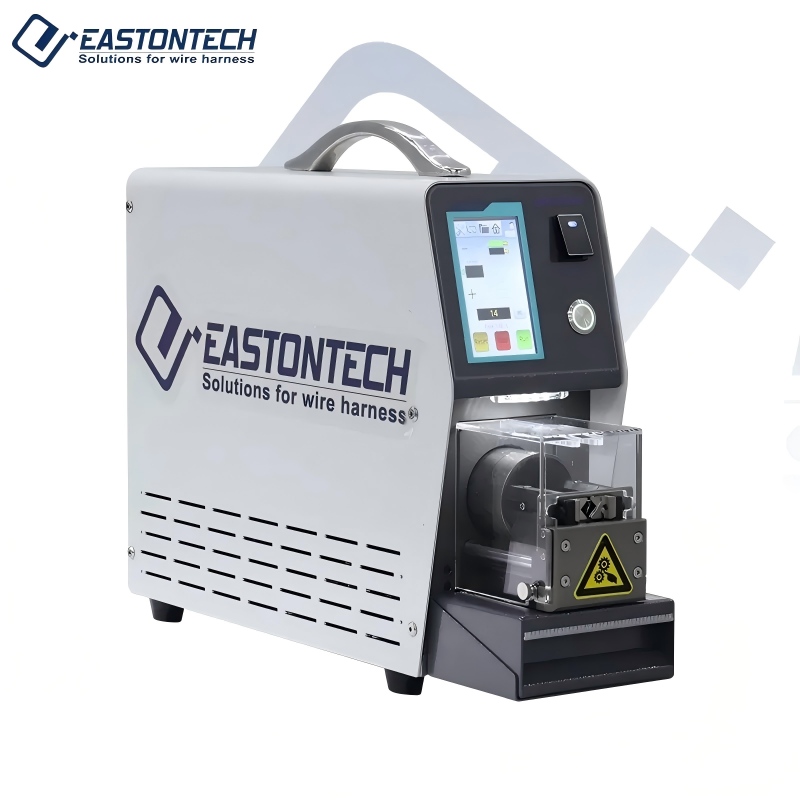
What Determines the Stripping Accuracy of a Coaxial Cable Machine?
Several mechanical factors determine stripping accuracy. Cable positioning is one of the most important because the cutting mechanism can only produce a consistent result if the cable itself remains in a stable position.
Cutting depth is another critical variable. The tool must remove the intended layer without penetrating into the next layer. This requires a combination of appropriate tooling, accurate adjustment, stable mechanical movement, and suitable processing parameters.
Feeding accuracy directly affects stripping length. If the cable advances too far or not far enough, the final stripping position changes even when the cutting mechanism is functioning correctly.
Material properties also affect the result. Soft jackets may deform during processing, while harder materials may require different cutting conditions. Dielectric materials can have different resistance to cutting and different responses to mechanical pressure.
| Processing Factor | Effect on Accuracy | What Manufacturers Should Evaluate |
|---|
| Cable outside diameter | Determines basic machine compatibility | Actual cable diameter and allowable range |
| Jacket material | Affects cutting and stripping behavior | Material type, hardness, and flexibility |
| Shield structure | Influences processing method | Braid, foil, or multiple shielding layers |
| Dielectric thickness | Determines allowable cutting depth | Actual construction and tolerance |
| Conductor size | Influences final conductor exposure | Conductor diameter and construction |
| Stripping length | Affects connector preparation | Required length and tolerance |
| Feeding stability | Controls processing position | Repeatability during continuous production |
| Tooling condition | Influences cutting consistency | Wear, alignment, and service life |
How Does Cable Construction Affect Machine Selection?
Cable construction should be analyzed before machine selection because it determines the number and type of processing operations required.
A basic coaxial cable may have a relatively simple structure consisting of an outer jacket, shield, dielectric, and conductor. Other cable designs can contain multiple shielding layers or specialized insulation materials. Such differences can substantially change the processing requirements.
Shield construction deserves particular attention. Braided shields and foil shields behave differently during cutting and preparation. A machine must be configured so that the required material can be removed without causing unnecessary deformation to the remaining structure.
Multi-layer cables create an additional challenge because different layers may need to be exposed to different lengths. This means the machine must control not only the total strip length but also the relative position of each layer.
For this reason, manufacturers should provide actual cable samples or detailed cable drawings when evaluating equipment. Sample processing can reveal issues that are not apparent from dimensional specifications alone.
What Is the Difference Between Coaxial Cable Stripping and Standard Wire Stripping?
The major difference is the number of functional layers that need to be controlled. Standard insulated wire generally consists of a conductor surrounded by an insulation layer. Coaxial cable introduces additional layers between the conductor and the outer surface.
This makes depth control more demanding. The machine may need to remove the outer jacket while preserving the shield, then process the shield and dielectric according to the connector or application requirements.
Another important difference is the effect of layer geometry on the final application. With coaxial cable, the relationship between conductor, dielectric, and shield can be important to the electrical characteristics of the completed assembly.
As a result, conventional wire stripping equipment should not automatically be considered suitable for coaxial cable. Actual cable testing is a much more reliable basis for equipment selection.
How Important Is Feeding Accuracy in Coaxial Cable Processing?
Feeding accuracy is fundamental because it determines where the cable reaches the processing position. Any feeding variation can become a dimensional variation in the finished cable.
Flexible coaxial cables can be particularly sensitive to feeding conditions because they may bend, move, or compress during transportation through the machine. Stable guides and feeding components help maintain a consistent cable path.
For high-volume production, manufacturers should evaluate feeding repeatability over multiple cycles rather than checking only the first few samples. Stable feeding is one of the foundations of repeatable stripping.
It is also important to consider how the machine handles different cable diameters. If several cable models are processed on the same equipment, the feeding system needs to maintain appropriate control after product changeovers.
Does Machine Speed Affect Coaxial Cable Processing Quality?
Machine speed should be considered together with processing stability. A higher nominal cycle rate is useful only if the machine can maintain acceptable quality at that speed.
Increasing processing speed can increase the demands placed on cable feeding, positioning, cutting, and material handling. If the system becomes unstable at a particular speed, the theoretical productivity advantage can quickly disappear through rejects, interruptions, or additional inspection.
For this reason, manufacturers should compare effective production output rather than nominal speed alone. A slightly slower machine that consistently produces conforming cables can provide greater usable capacity than a faster machine with unstable quality.
Processing complexity also affects practical cycle time. A simple jacket-strip operation naturally requires less processing time than a multi-stage application involving jacket removal, shield preparation, dielectric stripping, and conductor exposure.
What Role Does Tooling Play in Coaxial Cable Processing Accuracy?
Tooling is the physical interface between the machine and the cable, so its design has a direct effect on processing quality.
Cutting blades must be appropriate for the material and geometry being processed. Guides and fixtures need to maintain stable positioning. Stripping components need to apply controlled mechanical movement without unnecessarily deforming the cable.
Tool wear should also be treated as a production-quality issue rather than simply a maintenance issue. As cutting edges wear, the processing result can gradually change. The machine may continue operating normally while the dimensions of the processed cable begin to drift.
Manufacturers should establish inspection procedures based on actual production experience. Instead of waiting for obvious defects, dimensional inspection can be used to identify gradual changes in processing performance.
How Can Manufacturers Control Multi-Layer Coaxial Cable Processing?
Multi-layer processing requires precise control of the position and depth of each operation. The machine must know where the outer jacket should end, where the shield should be prepared, and how much dielectric and conductor should remain exposed.
Because these dimensions are related, an error in one stage can influence the next. This is why multi-stage coaxial processing requires more than simply setting a single stripping length.
Programmable processing parameters can help manufacturers establish repeatable recipes for different cable models. Once a cable has been validated, its settings can be stored and recalled during future production runs.
This approach is particularly useful for manufacturers with multiple products. It reduces the need to recreate machine settings manually and helps operators follow a standardized process.
Why Is Parameter Management Important for Coaxial Cable Machines?
Parameter management becomes increasingly valuable as production variety increases. Different cables may require different feeding distances, stripping lengths, cutting depths, and processing sequences.
Without controlled parameter storage, operators may rely on handwritten notes or personal experience when changing products. This creates opportunities for setup errors, particularly when several cable models have similar external appearances but different internal structures.
A stored recipe provides a standardized reference. Operators can select the appropriate cable model, verify the tooling, perform first-piece inspection, and then begin production using the validated settings.
Parameter management does not replace quality control. Instead, it provides a more reliable starting point and makes the process easier to reproduce between operators and production shifts.
How Should Manufacturers Evaluate a Coaxial Cable Machine Before Purchase?
Machine evaluation should be based on actual cable samples and production requirements. General specifications are useful for preliminary screening, but they cannot fully demonstrate how the equipment will process a particular cable.
The first stage should confirm basic compatibility, including cable diameter, material construction, shield type, conductor size, and required processing stages.
The second stage should involve sample processing. Manufacturers should inspect the jacket edge, shield condition, dielectric surface, conductor exposure, and stripping dimensions.
Repeatability should then be evaluated by processing a larger series of samples. Producing one acceptable cable demonstrates that the machine can perform the operation. Producing a consistent batch provides much stronger evidence that the process is suitable for industrial production.
Manufacturers evaluating their broader wire-processing requirements may also consider the cable harness machine range when coaxial cable preparation forms part of a larger harness-production workflow. However, equipment selection should always be based on the actual process requirements rather than the product category name alone.
What Production Tests Should Be Performed After Machine Setup?
After the machine has been configured, manufacturers should establish a structured verification procedure. The first step is dimensional inspection of the processed cable.
Stripping length should be measured at multiple points and across multiple samples. This helps determine whether the machine is producing a stable process rather than an isolated acceptable result.
Visual inspection should then confirm the condition of the jacket, shield, dielectric, and conductor. Particular attention should be paid to unintended cuts, deformation, exposed material, or damage to layers that should remain intact.
Downstream assembly should also be considered. If the cable will be terminated with a connector, sample cables should ideally be evaluated through the relevant assembly process. A stripping operation is successful only when its output is suitable for the next manufacturing stage.
How Does Preventive Maintenance Affect Processing Reliability?
Long-term processing reliability depends on maintaining the machine in its validated mechanical condition. Feeding components, cutting tools, guides, fixtures, and sensors can all experience normal wear during production.
Maintenance should therefore focus on the components that directly affect cable positioning and cutting depth. Any looseness, contamination, misalignment, or wear can gradually introduce processing variation.
Tooling inspection is particularly important. Cutting performance may deteriorate gradually before a machine generates an obvious mechanical fault. Monitoring finished cable dimensions can therefore provide an early indication that maintenance is required.
Preventive maintenance also helps production planning. If a particular tooling component consistently reaches a defined wear condition after a certain production volume, manufacturers can schedule replacement rather than waiting for quality problems to occur.
Can One Coaxial Cable Machine Process Different Cable Types?
Some machines are capable of processing multiple cable types, but compatibility should always be verified using the actual cable construction.
Different jacket materials, shield structures, dielectric thicknesses, and conductor sizes may require different parameters or tooling. Similar outside diameters do not necessarily mean that two cables can be processed using the same configuration.
For manufacturers with many cable models, programmable recipes and flexible tooling can be valuable. However, flexibility should be balanced against changeover time and setup complexity.
For high-volume products, a dedicated and highly optimized configuration may provide better productivity. For high-mix production, quick changeovers and parameter storage may be more important.
How Does Coaxial Cable Processing Affect Downstream Connector Assembly?
The quality of cable preparation directly affects connector assembly. Connectors are designed around specific relationships between the conductor, dielectric, shield, and connector components.
If conductor exposure varies, connector positioning can become inconsistent. If the dielectric is damaged or positioned incorrectly, the termination process may become more difficult. If the shield is improperly prepared, mechanical assembly and electrical performance can both be affected.
Consistent cable processing therefore provides a more predictable input for downstream equipment. This is particularly important for manufacturers seeking to automate connector insertion, crimping, soldering, or other termination operations.
From a production-engineering perspective, cable preparation should be evaluated as part of the complete manufacturing sequence rather than as an isolated operation.
What Are the Key Specifications to Compare Between Coaxial Cable Machines?
Machine specifications should be compared against the actual production requirements. A wide processing range can be useful, but it does not automatically indicate that the machine will provide the required precision for every cable within that range.
| Specification | Production Significance | Buyer Verification |
|---|
| Applicable cable diameter | Defines basic mechanical compatibility | Compare with actual cable specifications |
| Processing method | Determines which layers can be processed | Confirm jacket, shield, dielectric, and conductor operations |
| Stripping length range | Affects connector preparation flexibility | Verify required dimensions and tolerances |
| Feeding accuracy | Controls processing position | Test repeatability during continuous production |
| Tooling configuration | Influences cutting quality and changeover | Check compatibility and replacement requirements |
| Parameter storage | Improves production repeatability | Verify recipe storage and recall functions |
| Cycle time | Influences theoretical production capacity | Compare with effective conforming output |
| Maintenance requirements | Affect long-term production stability | Review wear components and service procedures |
Why Should Sample Testing Be Part of the Purchasing Decision?
Sample testing provides evidence that cannot be obtained from a specification sheet alone. It shows how the machine interacts with the actual cable material and construction.
During a sample trial, manufacturers should evaluate dimensional accuracy, layer protection, processing finish, feeding stability, cycle time, and repeatability.
Multiple consecutive samples are more informative than a single test piece. A longer production trial can also reveal potential changes associated with tooling wear or continuous machine operation.
For high-volume applications, sample testing should ideally simulate actual production conditions. This gives manufacturers a better basis for determining whether the equipment can meet their quality and productivity targets over time.
How Can Eastontech Help Manufacturers Select the Right Processing Solution?
Eastontech approaches wire and cable processing equipment from the perspective of practical production requirements. For coaxial applications, the appropriate machine configuration depends on cable construction, processing sequence, tooling, production volume, and downstream assembly requirements.
Actual cable samples are particularly valuable during the equipment-selection process. They allow the processing method to be evaluated under realistic conditions and provide a basis for checking stripping quality and repeatability.
For manufacturers whose production also includes ferrule termination, the cable ferrule machine can be relevant to a broader automated wire-processing workflow. Different processing stages should be matched to their actual applications instead of forcing one machine configuration to cover unrelated operations.
The same principle applies to production planning. Manufacturers should evaluate not only the initial equipment price but also changeover time, tooling consumption, maintenance requirements, operator involvement, scrap, rework, and effective output.
What Makes a Coaxial Cable Machine Reliable for Long-Term Production?
Long-term reliability comes from the combination of mechanical stability, process control, appropriate tooling, and disciplined maintenance. A machine that performs well during an initial demonstration still needs to maintain its processing accuracy after extended production.
Feeding components must continue to position the cable consistently. Cutting tools need to retain their functional geometry. Mechanical assemblies should remain properly aligned, and production parameters should be reproducible after changeovers.
Serviceability is also important. Wear components should be accessible, tooling replacement should be manageable, and maintenance procedures should be clearly defined.
From the production manager's perspective, reliability means predictable output. A machine that requires frequent manual adjustment can introduce hidden labor and quality costs even when its initial purchase price is competitive.
How Does Coaxial Cable Processing Accuracy Affect Production Cost?
Processing accuracy has a direct relationship with manufacturing cost. Every defective cable can consume material, labor, inspection time, and downstream processing capacity.
If a stripping defect is discovered immediately after processing, the cost may be limited to the cable and the processing cycle. If the same defect is discovered only after connector assembly, additional labor and components may already have been consumed.
Consistent automated processing can therefore reduce the risk of variation entering later production stages. This is particularly valuable when processing specialized or relatively expensive coaxial cable.
Manufacturers should evaluate the total economic effect of the machine rather than focusing only on purchase price. Scrap, rework, labor requirements, tooling life, downtime, maintenance, and effective production capacity all contribute to the actual cost of ownership.
How Should Manufacturers Balance Flexibility and Processing Precision?
Flexibility is valuable when it supports the manufacturer's actual production model. However, maximum flexibility is not always the best solution.
A manufacturer producing one cable continuously may benefit from optimized tooling and a highly stable process. A manufacturer producing many cable models may benefit more from programmable parameters and fast changeovers.
The key is to identify the actual level of product variation. Equipment should provide enough adjustment capability to cover the expected product range while keeping each validated production configuration stable.
In other words, manufacturers should avoid paying for flexibility that will rarely be used while also avoiding a machine that is too specialized for the company's future production requirements.
Frequently Asked Questions
1. What is the most important factor when choosing a coaxial cable machine?
The most important factor is compatibility with the actual cable construction and required processing sequence. Cable diameter is only one consideration. Jacket material, shield structure, dielectric thickness, conductor size, stripping dimensions, tooling, and downstream termination requirements should also be evaluated.
2. How accurate should a coaxial cable stripping machine be?
The required accuracy depends on the cable specification and downstream application. Manufacturers should establish acceptable dimensional tolerances according to their own product requirements and then verify through sample testing that the machine can maintain those limits consistently.
3. Can a coaxial cable machine process cables with multiple shielding layers?
Some automated systems can process multi-layer coaxial cables, but the capability depends on the machine configuration and tooling. Manufacturers should provide actual cable samples or detailed construction drawings so the required processing sequence can be evaluated before equipment selection.
4. Does automatic processing prevent damage to coaxial cables?
Automation reduces operator-dependent variation, but it does not automatically guarantee damage-free processing. Correct tooling, cutting depth, cable positioning, and parameter settings are all required to protect the internal cable structure.
5. Is a high-speed coaxial cable machine always better?
No. Effective productivity depends on speed, quality, stability, changeover time, and rejection rate. A slightly slower machine can provide better overall production performance if it maintains stable quality and requires less intervention.
6. What information should be provided when requesting a quotation?
Manufacturers should provide cable diameter, conductor size, jacket and dielectric materials, shield construction, required stripping lengths, processing sequence, expected production volume, target cycle time, and downstream termination requirements. Actual cable samples are highly recommended because they allow the supplier to evaluate the processing result directly.
Conclusion
Choosing a coaxial cable machine is ultimately a process-engineering decision. The right equipment must match the cable's physical construction while providing controlled feeding, accurate cutting depth, repeatable stripping dimensions, appropriate tooling, and stable operation throughout production.
Because coaxial cables contain multiple functional layers, processing accuracy cannot be judged by stripping length alone. The condition of the shield, dielectric, conductor, and jacket must also be considered, particularly when the processed cable will enter an automated connector-assembly process.
Manufacturers comparing equipment should therefore combine technical specifications with representative sample testing. Cable compatibility, tooling design, feeding accuracy, parameter management, changeover requirements, maintenance, effective output, and total production cost all deserve consideration before the final purchasing decision.
With appropriate equipment configuration and process validation, automated coaxial cable processing can reduce operator-dependent variation, improve repeatability, support higher production efficiency, and provide a more stable foundation for downstream termination. For manufacturers working with demanding cable-processing applications, selecting equipment around the actual production process is the most reliable way to achieve long-term accuracy and consistency.
External References
https://www.ipc.org/TOC/IPC-A-620C.pdf
https://webstore.iec.ch/en/publication/96934
https://www.te.com/en/products/application-tooling/high-voltage-wire-processing-equipment/high-voltage-cable-processing.html
 English